1
Discolored teeth
Some stains do not respond well enough to whitening. In selected cases, veneers can mask discoloration and create a more uniform appearance.
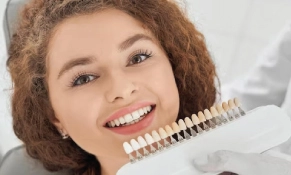
A confident smile is not only about having straight teeth. The shape, colour, size, spacing, and symmetry of your front teeth can also affect how your smile looks.
Dental veneers in Islamabad can improve selected cosmetic concerns by placing thin, custom-made restorations over the front surfaces of teeth. Depending on your needs, veneers may help improve the appearance of stained, chipped, misshapen, uneven, or slightly spaced teeth.
At OraDent Dental Clinic, cosmetic dental treatment is planned around your existing teeth, oral health, smile goals, and the result you want to achieve. The first step is an assessment to determine whether veneers are actually the most appropriate option for you.
If your concern is tooth colour, small chips, gaps, uneven shape, or the overall appearance of your smile, book a consultation to discuss your options.
Book your cosmetic dentistry consultation at OraDent Dental Clinic in Islamabad.
Understanding the treatment
Dental veneers are thin, custom-made coverings that fit over the front surface of a tooth. They are generally made from porcelain or tooth-coloured composite material and are primarily used to improve the appearance of teeth.
Veneers can help conceal or improve the appearance of concerns such as:
They are different from crowns. A veneer generally covers the front surface of a tooth, while a crown covers much more of the tooth and is often used when a tooth needs greater structural restoration.
Suitable cosmetic concerns
Veneers are most useful when your main concern is the appearance of otherwise suitable teeth.
Some stains do not respond well enough to whitening. In selected cases, veneers can mask discoloration and create a more uniform appearance.
A veneer may improve the appearance of a chipped front tooth when enough healthy tooth structure remains.
Teeth that look unusually small, narrow, irregular, or disproportionate may sometimes be reshaped visually with veneers.
Veneers can sometimes mask or close the appearance of small spaces between teeth.
In certain cases, veneers can make the visible alignment and proportions of the smile look more uniform.
However, veneers are not a substitute for orthodontic treatment when teeth require significant movement.
Before treatment
A good cosmetic outcome begins with selecting the right patient and the right treatment.
Your dentist may assess:
Existing cavities or gum disease should generally be addressed before veneer treatment. Patients with significant grinding or certain bite conditions may also need a different approach.
This is why a consultation should come before choosing a veneer material or ordering a fixed number of teeth.
Treatment options
The two main categories most commonly discussed are porcelain veneers and composite veneers.
Porcelain veneers are custom-made shells designed to fit the front of the tooth. They are generally valued for:
They are usually the more expensive option.
Composite veneers use a tooth-coloured resin material that is bonded and shaped directly on the tooth. Potential advantages include:
Composite is less resistant to staining and wear than porcelain, so the two options should not be treated as interchangeable.
Material and treatment choice
E-max is a ceramic material/system commonly associated with lithium-disilicate restorations.
Because “E-max” is widely used in cosmetic-dentistry marketing, it should not automatically be presented as the best option for every patient.
The appropriate restoration depends on your teeth, cosmetic goals, bite, available tooth structure, and the treatment plan recommended by your dentist.
OraDent should confirm the exact veneer materials currently offered before this section is finalized for publication.
| Feature | Porcelain Veneers | Composite Veneers |
|---|---|---|
| Material | Ceramic/porcelain | Tooth-coloured composite resin |
| Appearance | Highly aesthetic and natural-looking | Can provide good cosmetic results |
| Stain resistance | Generally better | More susceptible to staining |
| Preparation | Usually requires some enamel preparation | May require less enamel removal |
| Repairs | More involved | Generally easier to repair |
| Visits | Often requires more than one appointment | Can sometimes be completed with fewer visits |
| Cost | Usually higher | Usually lower |
| Longevity | Generally longer-lasting than composite | Usually shorter-lived than porcelain |
Porcelain: Ceramic/porcelain
Composite: Tooth-coloured composite resin
Porcelain: Highly aesthetic and natural-looking
Composite: Can provide good cosmetic results
Porcelain: Generally better
Composite: More susceptible to staining
Porcelain: Usually requires some enamel preparation
Composite: May require less enamel removal
Porcelain: More involved
Composite: Generally easier to repair
Porcelain: Often requires more than one appointment
Composite: Can sometimes be completed with fewer visits
Porcelain: Usually higher
Composite: Usually lower
Porcelain: Generally longer-lasting than composite
Composite: Usually shorter-lived than porcelain
The exact choice should be based on your clinical condition and cosmetic goals, not simply on which option is more expensive.
Treatment journey
The exact process depends on the type of veneer and your individual case, but treatment commonly involves several stages.
Your dentist discusses what you want to change and examines your teeth, gums and bite. This is also the stage to ask whether veneers are actually the best solution.
Existing decay, gum problems, damaged teeth, or other oral-health concerns may need treatment before cosmetic work begins.
Your dentist determines:
Depending on the treatment plan, dental impressions or digital scans may be taken. Impressions can be used to create custom restorations such as veneers.
If preparation is required, a small amount of enamel may be removed so the veneer can fit properly. The amount of preparation varies by tooth, veneer type, and treatment plan.
Where needed, temporary veneers may be used while laboratory-made restorations are being prepared.
The dentist checks factors such as:
Adjustments can be made before final bonding.
Once the restoration is approved, the veneer is bonded to the tooth.
Your dentist checks the result and can advise you on long-term care.
Before treatment
This is one of the most important questions to ask before treatment.
For many porcelain veneers, some enamel needs to be removed to make room for the restoration and help it fit correctly.
The amount is not identical for every patient.
Some treatment plans may use minimal-preparation approaches, but no-prep or minimal-prep veneers are not suitable for everyone.
Be cautious of claims that every patient can receive veneers with “zero enamel removal.”
Your dentist should explain exactly what preparation your teeth require before treatment starts.
Long-term expectations
“Permanent” and “long-lasting” do not mean the same thing.
Many traditional veneer treatments involve enamel removal and therefore are not reversible. Veneers can also eventually need repair or replacement.
The lifespan varies according to:
Cleveland Clinic reports an average lifespan of around 10–15 years for veneers with proper care, while longevity can vary considerably between individuals and restorations.
The important point is:
Veneers can be long-lasting, but they should not be described as a lifetime treatment that never needs replacement.
Clinical considerations
Veneers can be an appropriate cosmetic treatment for suitable patients when properly planned and placed by a qualified dentist.
However, they are not risk-free.
Potential concerns include:
The best way to reduce unnecessary risk is to have healthy teeth and gums assessed before treatment and to follow your dentist's recommendations.
Making an informed decision
Veneers do not automatically “damage” healthy teeth, but traditional veneer treatment may involve permanent enamel removal. That is why treatment planning matters.
If decay or gum disease is present, those problems generally need to be addressed before cosmetic treatment.
The bigger question is not:
“Are veneers good or bad?”
It is:
“Are veneers appropriate for my teeth, and can they achieve my cosmetic goal without unnecessary treatment?”
That decision should be made after an examination.
Compare your options
Dental bonding can sometimes achieve a cosmetic improvement without the same level of tooth preparation associated with porcelain veneers.
Cleveland Clinic notes that bonding generally requires less enamel removal and is more reversible, while porcelain veneers involve enamel removal and are not reversible once placed.
| Factor | Veneers | Composite Bonding |
|---|---|---|
| Main purpose | Cosmetic reshaping/covering | Cosmetic reshaping/repair |
| Enamel removal | Often required for porcelain | Usually less extensive |
| Material | Porcelain/ceramic or composite | Composite resin |
| Stain resistance | Generally better with porcelain | Lower |
| Repair | More involved | Generally easier |
| Cost | Usually higher | Usually lower |
| Reversibility | Often not reversible | More reversible in many cases |
Veneers: Cosmetic reshaping/covering
Composite Bonding: Cosmetic reshaping/repair
Veneers: Often required for porcelain
Composite Bonding: Usually less extensive
Veneers: Porcelain/ceramic or composite
Composite Bonding: Composite resin
Veneers: Generally better with porcelain
Composite Bonding: Lower
Veneers: More involved
Composite Bonding: Generally easier
Veneers: Usually higher
Composite Bonding: Usually lower
Veneers: Often not reversible
Composite Bonding: More reversible in many cases
For a small chip or minor shape correction, bonding may sometimes be enough. Veneers may be more appropriate when broader cosmetic changes are required.
Choosing the right treatment
A veneer generally covers the front surface of the tooth.
A crown covers the tooth more extensively and is often used when a tooth needs structural restoration or protection.
This distinction matters.
A severely damaged tooth should not automatically receive a veneer simply because the patient wants a cosmetic improvement.
Your dentist should determine whether the tooth needs:
If your main concern is tooth colour, veneers may not be the first treatment you need.
Whitening can be appropriate when the issue is discoloration that responds to bleaching.
Veneers may be considered when:
Professional assessment helps distinguish a whitening case from a veneer case.
Veneers can sometimes make mildly irregular teeth appear more uniform, but they do not move teeth in the same way orthodontic treatment does.
If your main concern is:
braces or clear aligners may be more appropriate.
OraDent already provides orthodontic treatment options, making it possible to assess whether the cosmetic concern would be better addressed by orthodontics instead of masking tooth position with restorations.
There is no single price that applies to every veneer treatment.
The total cost may depend on:
When comparing dental veneers cost in Islamabad, do not compare the number alone. Ask what the quoted price actually includes.
Before starting treatment
Before starting treatment, clarify:
A lower price may represent a different material or treatment package.
OraDent should insert its current verified veneer pricing here after confirming the exact material, per-tooth fee and package inclusions.
Case-specific pricing
Many patients are interested in treating only their two front teeth rather than changing their entire smile.
The price for two veneers depends on:
It should not be assumed that a two-tooth case is simply “half the price” of another package.
The most accurate quotation comes after assessing the two teeth and deciding which restoration is appropriate.
Long-term care
Longevity varies.
Cleveland Clinic reports an average of around 10–15 years for veneers with good care, although individual results can differ.
Their lifespan can be affected by:
Proper maintenance does not make veneers indestructible, but it can help protect both the restoration and the natural tooth underneath.
Veneer maintenance
Porcelain veneers are generally more stain resistant than natural enamel, while composite materials are more susceptible to staining and wear.
That does not mean you can ignore your oral hygiene.
Coffee, tea, tobacco, and other strongly staining substances can affect the visible appearance of dental restorations and surrounding natural teeth over time.
Regular dental care remains important.
If something goes wrong
A veneer can chip, crack, wear, or become loose.
If this happens:
Depending on the damage, the veneer may need:
The ADA specifically notes that veneers may require repair, rebonding or replacement over time.
Long-term maintenance
Veneers do not replace good oral hygiene.
Continue to:
The natural tooth beneath and around a veneer can still develop dental problems, so maintaining healthy gums and teeth remains essential.
Smile design
A natural-looking smile is not simply about making every tooth extremely white.
Your dentist should consider:
The goal should be a result that fits your face and smile rather than a generic “one-size-fits-all” design.
Setting realistic expectations
Before-and-after cases can help you understand the types of cosmetic changes veneers may provide.
However, another patient's result should never be treated as a guarantee for your smile.
Differences in:
can significantly change the final outcome.
For this reason, genuine OraDent before-and-after cases, where patient consent has been obtained, would be much more valuable than generic stock photographs.
Cosmetic dental care
OraDent Dental Clinic currently identifies cosmetic dentistry as part of its dental services and presents veneers and bonding as cosmetic options for improving chipped or malformed teeth.
Its published dentist information includes clinicians with cosmetic-dentistry backgrounds, including Dr. Kaynaat Zamir, listed with BDS, RDS, FCPS (Operative & Endodontics) and Certified Cosmetic Dentist credentials, and Dr. Zainab Qureshi, listed as a Cosmetic Dentist and C-Orthodontist.
Shop No. 7, Pakland Business Center, Behind Allied Bank, I-8 Markaz, Islamabad.
Open in Google Maps →Office No. 14, Ground Floor, Hashim Plaza, Near MedCity Hospital, F-8 Markaz, Islamabad.
Open in Google Maps →The clinic's published information also highlights sterilized equipment, hygiene, patient comfort, and professional dental care.
Most importantly, the starting point should be assessment and treatment planning, not simply deciding in advance that veneers are the answer.
Plan your smile carefully
During a consultation, you can discuss:
This lets you make the decision with a clear understanding of both the benefits and limitations.